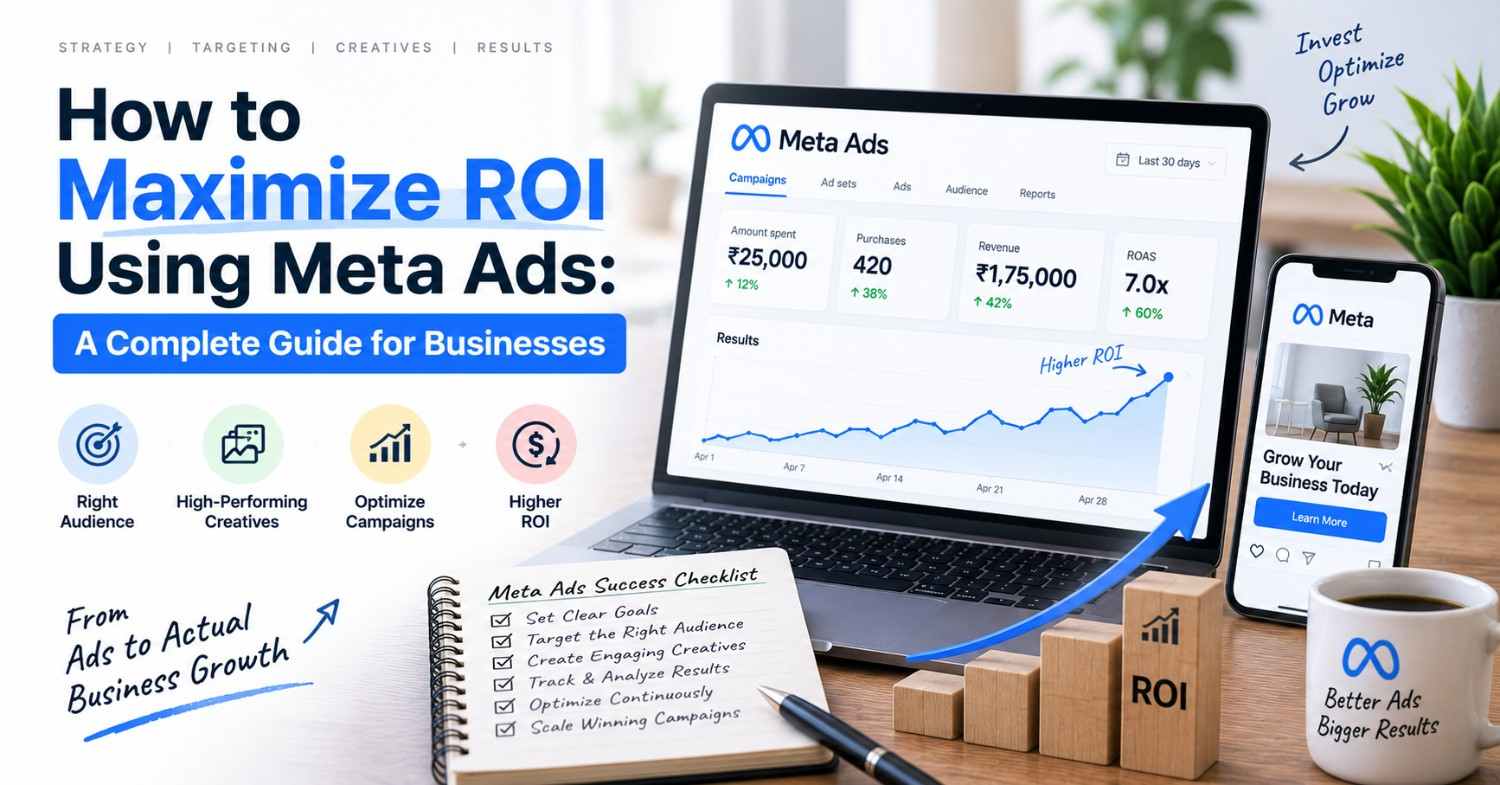
Meta Ads can be one of the most effective ways for businesses to reach the right audience, generate leads, drive sales and build brand awareness. But simply launching a campaign and increasing the budget does not guarantee a strong return on investment. Many businesses spend money on Facebook and Instagram ads without clearly understanding what is driving results.
The real challenge is maximizing ROI from Meta Ads while controlling acquisition costs and reaching people who are most likely to take action. From choosing the right campaign objective and audience to creating high-converting ads and optimizing campaigns with real data, every decision can affect your profitability.
What Is ROI in Meta Ads?
ROI (Return on Investment) measures how much value your business generates compared with the money invested in advertising.
A simple way to calculate it is:
ROI = (Revenue – Advertising Cost) ÷ Advertising Cost × 100
For example, if you spend ₹50,000 on Meta Ads and generate ₹2,00,000 in revenue:
ROI = (₹2,00,000 – ₹50,000) ÷ ₹50,000 × 100 = 300%
However, revenue isn't the only metric businesses should consider. For lead-generation campaigns, you may need to evaluate cost per lead, lead quality, conversion rate, customer acquisition cost (CAC) and eventual sales revenue.
1. Start With a Clear Meta Ads Goal
One of the biggest mistakes advertisers make is running Meta campaigns without a clearly defined business goal. Before spending your budget, decide what you want the campaign to achieve. A broader understanding of paid advertising can also help you determine where Meta Ads fit within your overall acquisition strategy. Such as:
- Brand awareness
- Website traffic
- Engagement
- WhatsApp conversations
- Lead generation
- App installs
- Online purchases
- Retargeting
- Sales
Your objective should match the action you want users to take. For example, if your goal is to generate property enquiries, optimizing purely for engagement may produce likes and comments but not necessarily qualified prospects. A lead or conversion-focused campaign may be more appropriate.
Expert Tip Don't judge campaign success only by the number of leads. A campaign generating 100 inexpensive leads can be less profitable than one generating 30 highly qualified leads that actually convert into customers.
2. Understand Your Target Audience
Meta gives advertisers access to extensive audience targeting options across Facebook and Instagram. But effective targeting isn't simply about adding as many interests as possible. Build your audience around factors such as:
- Age and location
- Demographics
- Interests and behaviors
- Previous website visitors
- Customer lists
- Instagram and Facebook engagement
- Video viewers
- People who interacted with your business
- Lookalike or similar audiences where appropriate
For businesses with enough first-party data, custom audiences and retargeting can be particularly valuable because these users have already demonstrated some level of interest.
Use Audience Segmentation
Instead of sending everyone to the same advertisement, consider separating audiences into groups such as:
Cold Audience → Engaged Audience → Warm Leads → Customers
This allows you to create different messages based on where someone is in the buying journey.
For example, a person who has never heard of your company may need educational content, while someone who visited your pricing page may respond better to a strong offer or consultation CTA.
3. Create Ads That Stop the Scroll
Even excellent targeting can struggle if your creative doesn't capture attention.
People scroll quickly through Facebook and Instagram, so your advertisement needs to communicate its value almost immediately.
Strong Meta ad creatives generally include:
- A clear visual hook
- One specific message
- A compelling benefit
- Easy-to-understand copy
- Strong branding
- A clear call to action
Test different formats, including:
- Short-form videos
- Reels
- Static images
- Carousels
- Customer testimonials
- Product demonstrations
- Before-and-after creatives
- Educational content
Don't assume that the most polished advertisement will always perform best. Sometimes a simple, authentic-looking creative can outperform a highly produced one.
4. Write Better Meta Ad Copy
Your primary text, headline and description should work together rather than repeating the same message. A useful structure is:
Problem → Benefit → Proof → CTA
For example:
Looking for a home in a well-connected location? Explore thoughtfully designed apartments with modern amenities and convenient access to everyday essentials. Schedule a site visit today.
Keep the message focused on what the customer gains rather than simply listing features.
Focus on Customer Intent
Use different messaging for different stages:
| Audience Stage | Recommended Message | Goal |
|---|---|---|
| Cold | Educational or problem-focused | Build awareness |
| Engaged | Benefits and differentiators | Generate interest |
| Warm | Testimonials, proof, offers | Encourage action |
| High Intent | Strong CTA and urgency | Drive conversion |
| Existing Customer | Cross-sell or upsell | Increase customer value |
This approach can improve the efficiency of your Facebook advertising strategy by making your messaging more relevant.
5. Use Retargeting to Recover Lost Opportunities
Not everyone converts on their first interaction with your business.
Someone might watch your video, visit your website, interact with your Instagram page or open a lead form without completing it.
This is where Meta retargeting becomes important. You can build audiences from people who:
- Visited specific website pages
- Engaged with your social profiles
- Watched your videos
- Opened or submitted lead forms
- Added products to their cart
- Previously purchased from you
A strong funnel could look like:
Awareness Campaign → Engagement → Retargeting → Conversion Campaign
This helps you continue the conversation with users who already know your brand.
6. Optimize Your Landing Page
Your Meta campaign doesn't operate in isolation.
You could have excellent targeting and compelling advertisements, but if your landing page is slow, confusing or difficult to use, conversions can suffer.
Your landing page should:
- Match the advertisement's message
- Load quickly
- Work well on mobile
- Clearly communicate the offer
- Include relevant trust signals
- Make the next step obvious
- Keep forms short and simple
For lead generation, ask only for information that is genuinely necessary at the first stage.
7. Track the Metrics That Actually Matter
Meta Ads Manager provides a large amount of data. The key is knowing which metrics matter for your business.
Important metrics include:
CTR (Click-Through Rate): Shows how effectively your ad encourages people to click.
CPC (Cost Per Click): Helps you understand the cost of generating traffic.
CPM (Cost Per 1,000 Impressions): Indicates how much you're paying to reach your audience.
CPL (Cost Per Lead): Particularly important for lead-generation campaigns.
CPA (Cost Per Acquisition): Measures the cost of acquiring a customer or desired conversion.
ROAS (Return on Ad Spend): Measures revenue generated for every unit of advertising spend.
For example, a 4X ROAS means the campaign generated ₹4 in attributed revenue for every ₹1 spent on advertising.
8. Test Before Increasing Your Budget
Scaling a campaign too quickly can hurt performance.
Instead, identify what is working first and then gradually increase investment.
Test variables such as:
- Creative
- Hook
- Primary text
- Headline
- Audience
- Landing page
- Offer
- Call to action
Avoid changing too many variables at once. If you change the audience, creative, budget and optimization strategy simultaneously, it becomes difficult to understand what actually improved performance.
9. Scale What Is Profitable
Once you identify a campaign, audience or creative producing profitable results, focus your budget on those opportunities.
You can scale by:
- Increasing budget gradually
- Introducing new creative variations
- Expanding successful audiences
- Testing broader targeting
- Building additional retargeting segments
- Improving the conversion funnel
However, scaling should be based on profitability, not vanity metrics. If increasing your advertising budget produces more leads but your sales team cannot qualify or follow up with them effectively, overall ROI may decline.
For businesses that need expert support with campaign management, creative testing and performance optimization, working with a digital marketing agency such as Muftlo can help create a structured and data-driven approach to Meta advertising.
Meta Ads ROI: What Businesses Should Focus On
A profitable Meta advertising strategy requires looking beyond individual advertisements.
| Area | What to Optimize |
|---|---|
| Campaign | Objective and conversion event |
| Audience | Relevance and buying intent |
| Creative | Hook, format and message |
| Copy | Benefits and CTA |
| Landing Page | Experience and conversion rate |
| Retargeting | Previous user interactions |
| Measurement | Leads, sales, CAC and ROAS |
| Scaling | Profitable campaigns and audiences |
The strongest results usually come when all these elements work together.
Conclusion
Maximizing ROI using Meta Ads isn’t about simply spending more money or finding one “perfect” audience. It’s about building a complete advertising system where the right audience sees the right message at the right stage of the customer journey. Strong creative, accurate tracking, relevant targeting, effective landing pages and continuous testing all contribute to better performance.
For businesses, the goal should be to move from simply measuring ad clicks and impressions to understanding the complete path from advertisement to customer. When you consistently analyze which campaigns generate qualified leads, sales and profitable customers, you can make smarter budget decisions and scale your Meta Ads with greater confidence.