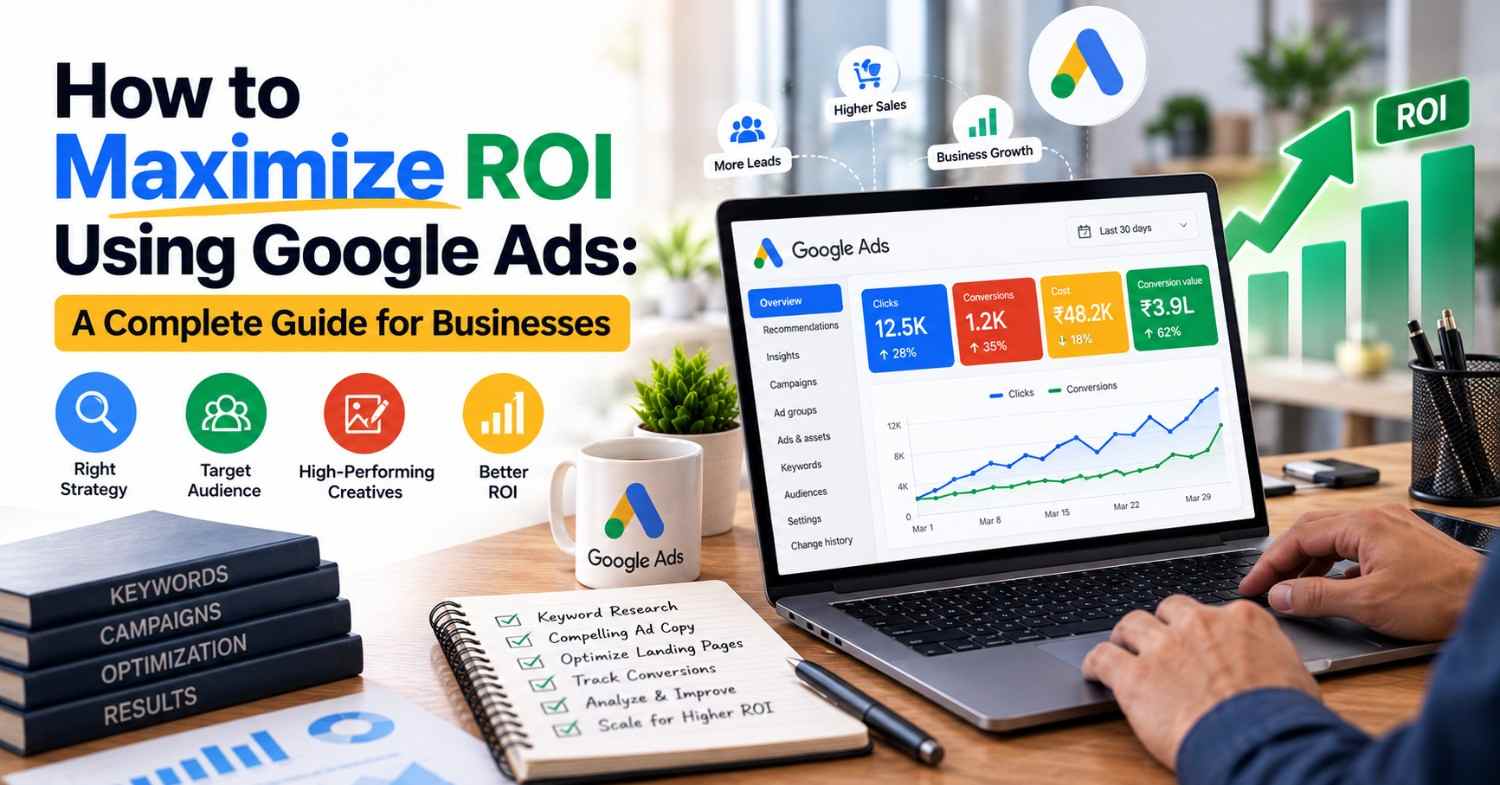
Running Google Ads can generate a steady flow of traffic, leads and sales, but simply spending more on campaigns does not guarantee better results. Many businesses struggle with high CPCs, low conversion rates, poor-quality leads and rising advertising costs. The real challenge is turning your ad budget into measurable business revenue.
That is where Google Ads ROI becomes important. Instead of focusing only on clicks or impressions, businesses need to measure how much revenue their campaigns generate compared with what they spend. With the right keywords, targeting, bidding strategy, landing pages, conversion tracking and continuous optimization, you can improve campaign efficiency and get more value from every advertising rupee.
Key Takeaways
- Focus on conversions and revenue rather than clicks alone.
- Choose keywords based on commercial intent and business objectives.
- Use conversion tracking to understand which campaigns generate results.
- Optimize landing pages to improve conversion rates.
- Test ad copy, offers, keywords and bidding strategies regularly.
- Use negative keywords to reduce irrelevant traffic.
- Compare campaigns performance based on profit and customer value.
- Consider professional Google Ads management services when campaigns become complex.
What Is Google Ads ROI?
Google Ads ROI measures the return your business receives from money invested in Google advertising.
A simple ROI formula is:
Google Ads ROI = (Revenue Generated − Advertising Cost) ÷ Advertising Cost × 100
For example, if you spend ₹20,000 on Google Ads and generate ₹80,000 in attributable revenue:
ROI = (₹80,000 − ₹20,000) ÷ ₹20,000 × 100 = 300%
However, revenue alone does not always tell the complete story. Businesses should also consider product margins, sales costs, customer acquisition costs and lifetime customer value when evaluating profitability.
1. Set Clear Google Ads Goals
Before launching a campaign, decide what you want Google Ads to achieve.
Your goal could be:
- Generate quality leads
- Increase online sales
- Drive phone calls
- Generate WhatsApp inquires
- Promote a specific service
- Increase booking or registrations
- Reach high-value customers
Your campaign structure, bidding strategy, ad copy and landing page should support that specific objective.
For example, a real estate business may prioritize qualified property inquiries rather than simply maximizing website traffic.
2. Target High-Intent Keywords
Keyword selection has a direct impact on campaign profitability.
Instead of targeting broad keywords that generate large volumes of low -intent traffic, identify searches that indicate the user is closer to taking action.
For example:
| Keyword Type | Example | Intent |
|---|---|---|
| Informational | how Google Ads works | Low–Medium |
| Commercial | best Google Ads agency | Medium–High |
| Service-based | Google Ads management services | High |
| Transactional | hire Google Ads agency | Very High |
High-intent keywords can sometimes have higher CPC’s but they may also bring visitors who are more likely to become customers.
Use Negative Keywords
Negative keywords help prevent your ads from appearing for irrelevant searches.
For example, a company selling paid marketing services may exclude searches containing terms such as:
- Free
- Course
- Jobs
- Salary
- Tutorial
- Certification
The exact exclusions should depend on your business and search-query data.
3. Write Ads Around Customer Intent
Your ads should quickly answer the user’s question: “Why should I click this ad?”
Effective Google Ads copy generally communicates:
- What you offer
- Who it is for
- A meaningful benefit
- A differentiator
- A relevant call to action
For example, instead of a generic headline such as:
Digital Marketing Services
you could communicate a clearer value proposition:
Performance Marketing Services for Growing Businesses
Your ad should also match the keyword and landing page. When the complete user journey is relevant, you can improve both user experience and campaign efficiency.
4. Optimize Landing Pages for Conversions
Getting a click is only the first step. If your landing page is confusing, slow, difficult to navigate or unrelated to the advertisement, you can lose potential customers even after paying for the click.
A conversion-focused landing page should have:
- A clear headline
- Strong value proposition
- Relevant information
- Visible CTA
- Trust signals
- Simple lead form
- Mobile-friendly design
- Fast loading experience
- Relevant testimonials or proof where appropriate
For example, an ad promoting Google Ads management services should ideally lead to a page specifically explaining those services rather than a generic homepage.
5. Track Conversions Correctly
You cannot optimize what you cannot measure. Setup conversion tracking for actions that matter to your business, such as:
- Form submissions
- Phone calls
- Purchases
- Sign-ups
- Bookings
- whatsApp clicks
- Qualified leads
For lead-generation businesses, it is especially important to distinguish between a lead and a qualified lead.
If Google Ads generate 100 leads but only five become customers, optimizing solely for lead volume may not maximize your actual ROI.
CRM integration and offline conversion tracking can help connect advertising activity with downstream sales outcomes.
6. Choose the Right Bidding Strategy
Google Ads provide different bidding approaches depending on campaign objectives and available conversion data.
Common approaches include:
- Manual CPC
- Maximize clicks
- Maximize Conversions
- Target CPA
- Maximize Conversion Value
- Target ROAS
The appropriate strategy depends on your campaign maturity, conversion volume, business model and data quality.
For ecommerce businesses with reliable revenue tracking, value-based bidding can help focus optimization on conversions with greater business value.
For lead-generation businesses, optimizing toward qualified or valuable conversions can be more meaningful than simply maximizing form submissions.
7. Improve Google Ads ROI Through Continuous Testing
A campaign should not be treated as a “set it and forget it” activity.
Regularly text:
Ad copy
Experiment with different benefits, headlines, CTAs and offers.
Landing Pages
Test headlines, forms, layouts, trust elements and calls to action.
Keywords
Review search terms and identify opportunities for new keywords or exclusions.
Audience Signals
Analyze which audiences, locations, devices and segments generate meaningful conversions.
Offers
Test different incentives or service propositions where appropriate. Small improvements across several parts of the funnel can create a significant overall impact.
Google Ads Agency vs Managing Campaigns In-House
Businesses often need to decide whether to manage campaigns internally or work with a specialist.
| Factor | In-house Management | Google Ads Agency |
|---|---|---|
| Initial control | High | High |
| Specialist expertise | Depends on team | Usually available |
| Testing capacity | Depends on resources | Often broader |
| Time requirement | Higher internally | Outsourced |
| Strategy support | Internal team | Agency expertise |
| Scalability | Depends on staff | Often easier |
| Cost structure | Employee + ad spend | Agency fee + ad spend |
An experienced Google Ads marketing agency can be useful when campaigns involve multiple products, locations, audiences, conversions actions or substantial advertising budgets.
However, businesses should evaluate an agency based on its reporting, tracking approach, transparency, strategic process and ability to connect advertising performance with actual business outcomes.
8. Focus on Profit, Not Just ROAS
ROAS and ROI are related but not identical.
ROAS = Revenue ÷ Advertising Cost
ROI = (Revenue − Cost) ÷ Cost
Suppose you spend ₹50,000 and generate ₹200,000 in revenue.
Your ROAS is 4x.
But if your product margins, operational expenses, sales costs and fulfillment costs are high, a 4x ROAS may not necessarily mean a highly profitable campaign.
Therefore, businesses should evaluate:
- Cost per qualified lead
- Customer acquisition cost
- Conversion rate
- Average order value
- Gross margin
- Customer lifetime value
- Revenue generated
This gives you a more realistic picture of advertising performance.
When Should You Hire a Google Ads Agency?
Managing Google Ads internally can work well when you have the necessary skills, time, tracking infrastructure and resources. However, larger accounts or complexes can require significant ongoing attention.
A Google Ads agency may help businesses with:
- Account and campaign setup
- Keyword research
- Conversion tracking
- Landing-page recommendations
- Campaign optimization
- Remarketing
- Performance reporting
- Budget management
Businesses looking for professional support can also consider a Google Ads marketing agency when they want an external team to manage strategy and execution.
For example, a digital marketing agency such as Muftlo can support businesses with performance-focused digital marketing activities.
Conclusion
Maximizing Google Ads ROI is not about simply increasing your advertising budget or chasing the lowest CPC. It requires a complete approach that connects keywords, advertisements, landing pages, conversion tracking, bidding and customer value. When these elements work together, businesses can make more informed decisions about where their advertising budget should go.
Start by improving the fundamentals: target relevant search intent, remove wasted traffic, strengthen landing pages, track meaningful conversions and regularly analyze campaign performance. As your data becomes more reliable, you can make smarter optimization and scaling decisions, helping turn Google Ads from a traffic-generation channel into a measurable business growth channel.